Property photography looks straightforward until you try it. Stand in a room, point the camera, click. Easy, right?
Wrong. The best property photographers understand composition, light, staging, and how to make a cramped bathroom look like a spa. They know that Estate agents don't just want photos – they want marketing ammunition that gets viewings booked.
If you're thinking about breaking into property photography in the UK, here's the realistic path from zero to paid shoots, including what gear you actually need and how to land your first clients without looking like an amateur.
Start by Learning the Craft (Before You Touch a Camera)
Here's what most beginners get wrong: they buy expensive gear first, then try to learn composition. Do it backwards.
Before you invest a penny, do this:
Go to Rightmove, Zoopla, OnTheMarket – anywhere estate agents list properties. Look at photos. Lots of them. Not the terrible ones (though you'll see plenty). Study the good ones.
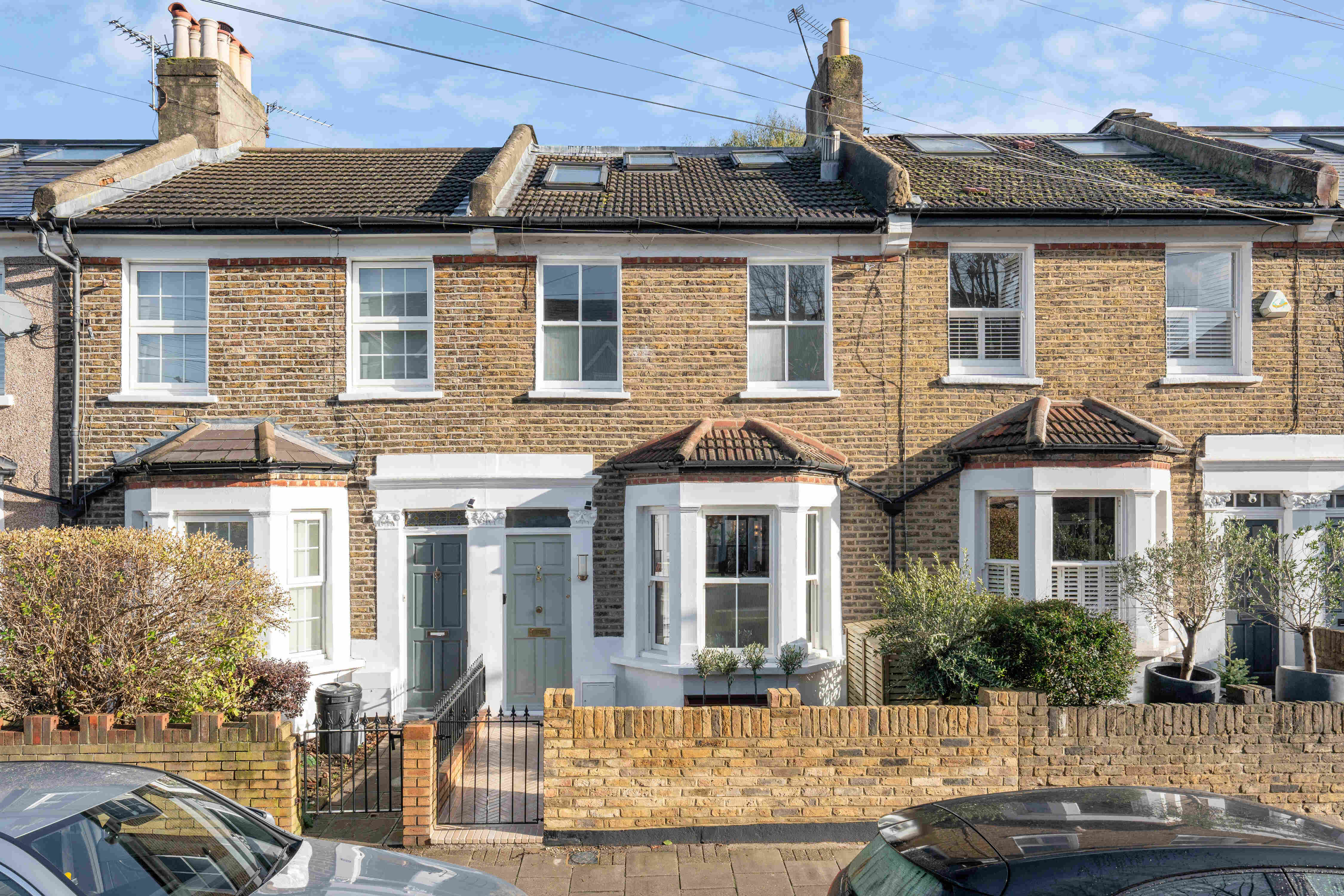
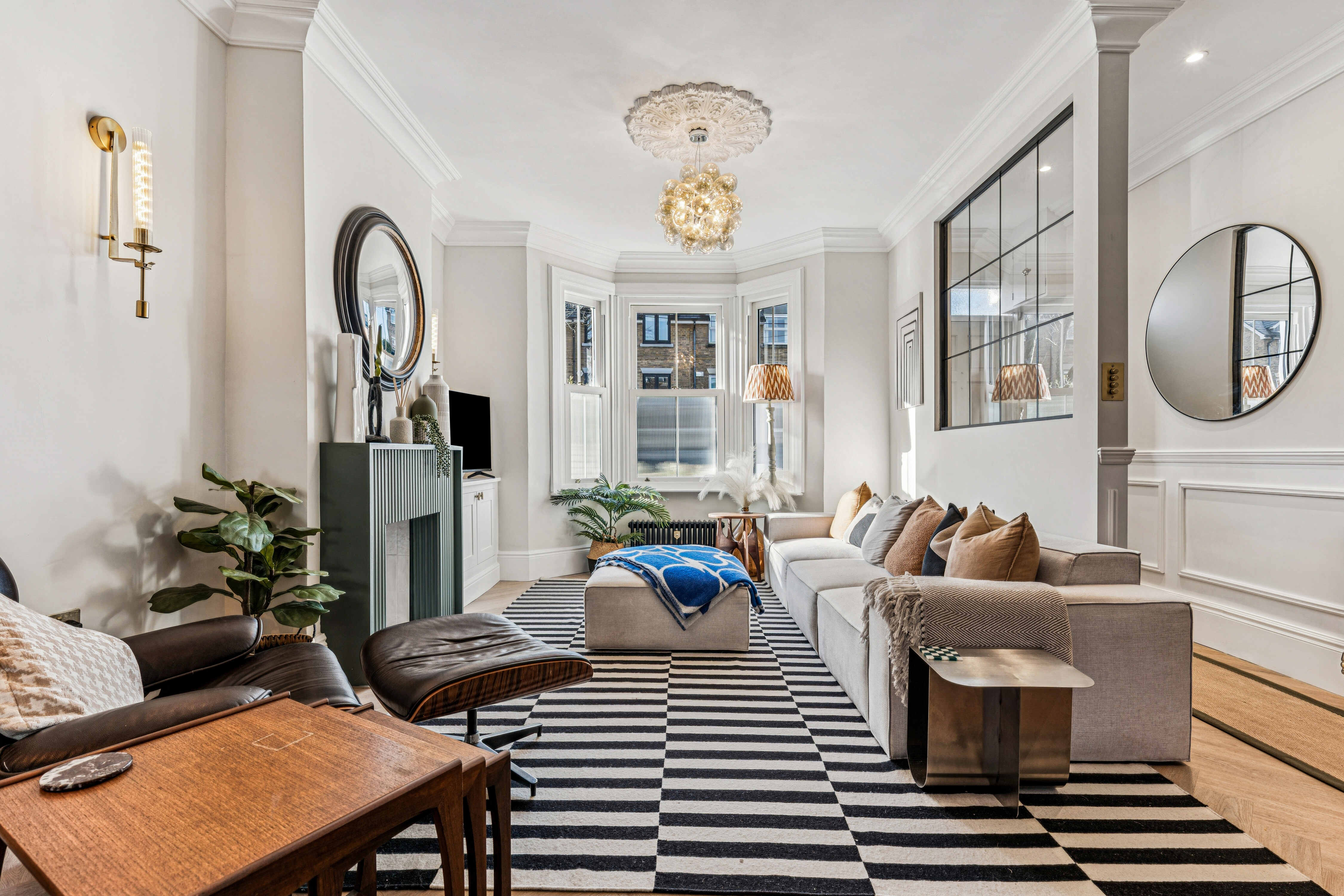
What makes a great property photo? Composition and staging. This is what separates competent from exceptional. Notice how the best shots:
Use natural lines to guide your eye through the space
Show depth (you can see into multiple rooms)
Are perfectly level (no wonky walls or leaning door frames)
Feel inviting but not cluttered
Capture the room's best angle, not just the widest
Walk around estate agents' windows. Look at the listings on display. Which photos make you want to view? Which ones feel flat or confusing? Start training your eye to recognise what works.
Then, learn the psychology of property marketing.
You're not just taking photos. You're solving a problem for estate agents: they need to generate viewings. Your images need to show space, light, and potential. A cramped hallway needs to look navigable. A dark kitchen needs to feel warm. A dated bathroom needs to look clean and functional.
Understanding this mindset – that you're creating marketing tools, not art – will shape every decision you make behind the camera.
The Gear You Actually Need (£1-2k Entry Point)
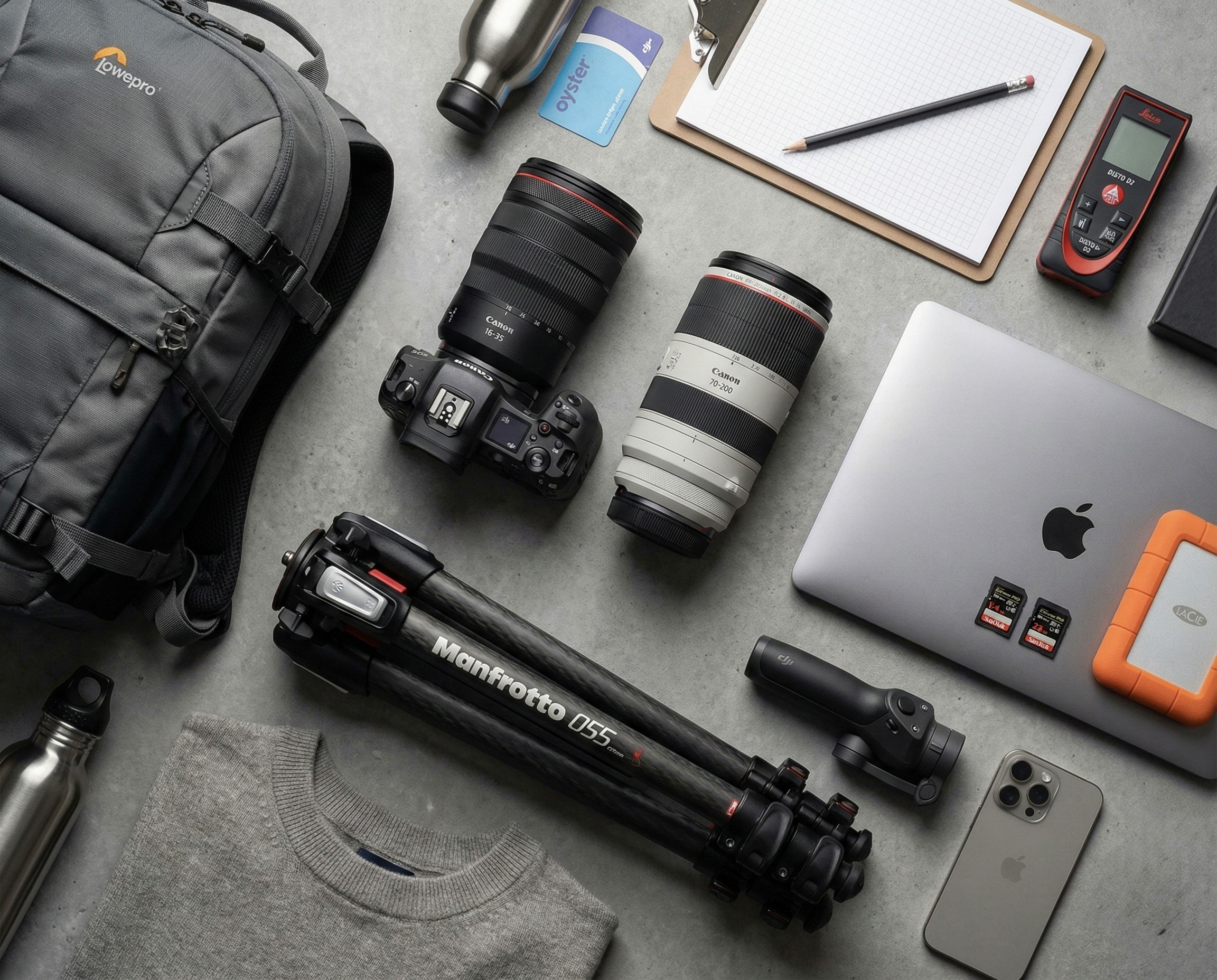
You don't need expensive kit to start. You need the right kit. Here's what matters:
1. A Full-Frame Camera (Or Good APS-C)
Full-frame sensors give you better low-light performance and flexibility, but they're not essential when you're starting out. What you do need:
Manual controls (aperture, shutter speed, ISO)
Ability to shoot in RAW format
Decent dynamic range (pulling detail from shadows and highlights)
Recommended starter options:
Sony A7 III (used, around £800-900) – excellent value, great low-light performance
Canon EOS R8 (new, around £1,500) – lightweight, solid entry into Canon's RF system
Nikon Z5 II (new, around £1,400) – beginner-friendly full-frame with in-body stabilisation
Canon 5D IV (old, around £600-800) - heavy but the old reliable and has access to a huge amount of lenses
Mirrorless is fine. DSLRs are fine. Don't get hung up on the latest model. Property photography doesn't need 40fps burst mode or 8K video. It needs sharp, well-exposed images.
2. A Wide-Angle Lens (16-35mm f/4) – This Is Non-Negotiable
If you're going to invest in one piece of kit, make it this. Wide-angle lenses are essential for property work because they show more of the room without making it look distorted.
Why 16-35mm f/4?
Wide enough to capture entire rooms without backing into walls
f/4 aperture keeps everything in focus (you want sharp detail throughout, not blurry backgrounds)
Affordable compared to f/2.8 alternatives
Where to buy:
Canon RF 16-35mm f/4 L IS USM (around £1,100)
Sony FE 16-35mm f/4 ZA OSS (around £900-1,100)
Nikon Z 14-30mm f/4 S (around £1,100)
Canon EF 16-35mm f/4 IS USM (around £700)
Buy this lens first. Skip the kit lens. It's not wide enough.
3. A Sturdy Tripod – No Cheap Rubbish
Property photography = tripod photography. You'll shoot at low ISOs for maximum image quality, which means slower shutter speeds. Handheld won't cut it. Cheap tripods wobble. Wobbly tripods = blurry photos. Don't waste £40 on something that'll frustrate you.
Go with Manfrotto. They're industry standard for a reason.
Manfrotto MT190XPRO4 Aluminium Tripod (around £150-200) – robust, reliable, proper payload capacity
Manfrotto BeFree Advanced (around £250 for carbon fibre) – lighter for moving between properties
You'll be lugging this around all day. Get something that balances stability with portability. Don't cheap out.
4. A Leica Disto (Laser Measure) – Market-Leading Durability
If you're also doing floorplans (and you should be – it's an easy upsell), you need a laser measure that won't break when you drop it. And you will drop it.
Leica Disto D2 BT (around £130) is the sweet spot. Bluetooth connectivity, 100m range, Leica build quality. It'll survive being knocked off tables, dropped in bags, and generally abused on site.
Cheaper alternatives exist. They also break faster. Leica Distos last.
5. A Proper Camera Bag
You're carrying expensive kit into strangers' homes. Protect it.
Look for:
Padded compartments
Weather resistance
Comfortable to carry when loaded
Lowepro ProTactic or Peak Design Everyday Backpack are popular with property photographers. Budget £100-150.
6. Fast WiFi Upload & Cloud/Hard Drive Storage
Estate agents want photos fast. Waiting 3 days for delivery is amateur hour it must be next day.
For file transfer:
Get a Google Workspace account with a custom domain (from £4.60/month). Loads of storage, easy file sharing, doesn't expire like WeTransfer.
WeTransfer can absolutely get in the bin. Files expire, links break, agents get annoyed.
For backup:
External hard drive (Seagate or WD, 2TB+, around £60-80)
Cloud backup (Google Drive, Dropbox, Backblaze)
Losing a client's photos because your laptop died is a career-ending mistake. Back up everything. Twice.
7. Editing Software (And Learning to Edit Fast)
You can't outsource editing when you're starting out – it's too expensive. Learn to do it yourself.
Adobe Lightroom is the industry standard. £9.98/month for Lightroom + Photoshop via Creative Cloud.
What you need to learn:
Exposure correction (lifting shadows, managing highlights)
HDR Blending
White balance (making tungsten bulbs look neutral, not orange)
Perspective correction – this is critical. If you can't shoot level (and no one does perfectly every time), you need to fix it in post.
Perspective correction is especially important for exteriors. If you're outsourcing editing, at least learn this skill. It's the unspoken connection between a photographer and their editor. Shoot it wrong, and even the best editor struggles.
Resources:
YouTube tutorials (free)
Phlearn, Fstoppers (paid courses, worth it if you're serious)
Editing fast and efficiently separates professionals from hobbyists. Aim to process a full property shoot (20-30 images) in under an hour once you've got your workflow nailed.
Getting Your First Jobs: Start Small, Build Trust
No one's giving you a £ 2 million penthouse to photograph when you've got zero portfolio. Start local and humble.
Step 1: Build a Portfolio (For Free)
Offer to photograph friends' or family members' homes for free. Style them properly (this is practice for the real thing). Shoot them like you'd shoot a listing.
You need 10-15 strong images across different property types: flats, terraced houses, detached homes, modern and period. Show range.
Step 2: Target Small, Independent Estate Agents
Large chains like Foxtons or Savills have supplier lists you need approval to join. Skip them for now.
Focus on:
Independent agents in your area
Smaller lettings agencies
New build developers who need marketing content
Walk in. Introduce yourself. Show your portfolio (on a tablet or printed). Explain you're building your business and offer competitive rates.
The pitch: "I'm a local property photographer building my client base. I'd love to work with you on a trial shoot – if you're happy with the results, we can discuss ongoing work."
Step 3: Nail Your First Paid Shoot
When you get that first job, over-deliver.
Turn up early
Dress professionally (you're entering people's homes)
Bring lens wipes, spare batteries, everything you might need
Communicate clearly (how long you'll need, when they'll get the photos)
Deliver on time
Transparency builds trust. Bullshit leads to one-and-done clients. If you promise same-day turnaround and deliver three days later, you're done.
Don't overpromise. Under-promise and over-deliver.
Step 4: Learn to Manage Conflict and Feedback
Agents will have opinions. Vendors will have opinions. You won't always agree.
This is where people skills matter as much as photography skills. If an agent asks for a reshoot because the photos aren't working, don't get defensive. Ask what specifically isn't working. Adapt.
Most complaints come from miscommunication, not bad photography. Set expectations upfront:
How many images they'll get
Turnaround time
What's included (retouching? Twilight shots?)
Step 5: Get Insured (Seriously)
You're entering people's homes with expensive equipment. If you knock over a vase, trip on a rug, or accidentally damage something, you're liable.
Get Public Liability Insurance (around £100-150/year). It's not optional.
Also consider Professional Indemnity Insurance if you're advising on staging or making recommendations that could impact a sale.
Simply Business and Hiscox offer photographer-specific policies.
Where Click Media Fits In (When You're Ready)
We work with experienced photographers, floorplanners, and videographers – but we don't employ them. They're all independent contractors.
Why? Because we believe creatives thrive with freedom. The ability to take on other work, grab those big day-rate shoots when they come in, work without office politics or annual leave restrictions – that's how you build a sustainable freelance career.
If you're just starting out, we're not your first step. We contract experienced professionals who already have their workflows dialled in.
But here's your pathway:
Start with Niche or Fourwalls – premium employers who train photographers, floorplanners, and Domestic Energy Assessors (DEAs) through structured training programmes. They'll teach you the ropes, give you consistent work, and help you build skills in a supported environment.
When that support starts feeling like a boundary – when you've outgrown the training wheels and want full creative and commercial freedom – that's when Click becomes relevant. We work with photographers who know what they're doing and want autonomy without the hassle of managing their own client pipeline.
We handle:
Client relationships
Scheduling
Quality assurance
Operations and admin
You handle:
Showing up, shooting well, delivering on time
It's a bridge from employment to full freelance. But you need to be good first.
The Reality Check: This Isn't a Get-Rich-Quick Career
Property photography can be lucrative, but it takes time to build. Expect:
6-12 months to establish a steady client base
£75-95 per shoot starting out (depending on property size and location)
£200-400+ per day once you're established with agencies and private clients
Your income will be inconsistent at first. Some weeks you'll have five shoots. Some weeks, none. Budget accordingly.
You're also competing with:
Agents who use their own staff photographers (often poorly)
Cheap freelancers undercutting on price
Established companies with long-term contracts
Your edge? Quality, reliability, and relationships. Agents will pay more for someone who shows up on time, delivers consistently, and makes their job easier.
Final Checklist: Are You Ready?
Before you invest in gear and quit your job, ask yourself:
Can you handle irregular income for 6-12 months?
Are you comfortable entering strangers' homes daily?
Can you take feedback (sometimes harsh) without taking it personally?
Are you organised enough to manage multiple shoots, deadlines, and clients?
Do you have a backup plan if this doesn't work out immediately?
If yes to all of the above, you're in a good position to start.
The Bottom Line
Property photography isn't glamorous. It's schedule management, file delivery, driving between jobs, and making dark Victorian terraces look inviting.
But if you're good at it – if you understand composition, can manage clients, and deliver consistently – there's work. Lots of it. The UK property market runs on photography, and agents need reliable people who make their listings look irresistible.
Start small. Invest smart (not expensive). Build relationships. Deliver quality. The work will come.
And when you're ready to step up from employment to contract work with a company that values creative freedom, we'll be here.